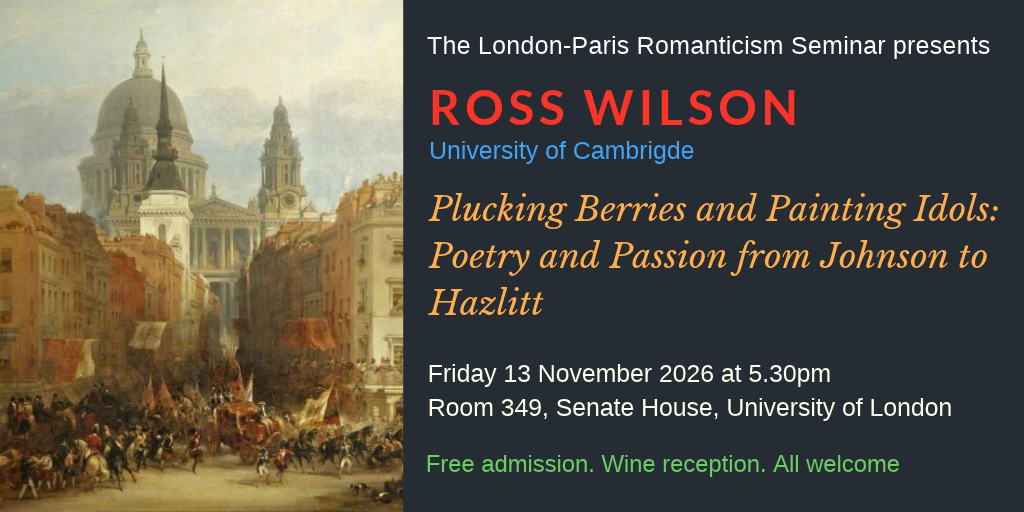
The next meeting of the London-Paris Romanticism Seminar will take place on Friday 13 November 2026 at 5.30pm in Room 349, Senate House, University of London. As our distinguished guest speaker, we are delighted to welcome Professor Ross Wilson of the University of Cambridge, who will present a paper entitled Plucking Berries and Painting Idols: Poetry and Passion from Johnson to Hazlitt. This will be followed by a discussion and wine reception. The event is free and open to everyone, including postgraduates and members of the public. The seminar will be chaired by Rowan Boyson.
Ross Wilson is Professor of the History and Theory of Criticism in the Faculty of English, University of Cambridge, and a Fellow of Emmanuel College. He works on eighteenth- and nineteenth-century poetry and on the history of criticism from the eighteenth century to the present. Ross is the author of books including Shelley and the Apprehension of Life (2013) and Critical Forms: Forms of Literary Criticism, 1750–2020 (2023), as well as editor of The Meaning of ‘Life’ in Romantic Poetry and Poetics (2009) and Percy Shelley in Context (2025). He is editor of the forthcoming British Romanticism volume for The Oxford History of Poetry in English and is beginning a project on the aesthetics and politics of balance in English literature of the long eighteenth century.
Regarding the subject of his paper, Ross writes:
“Following on from Paul Hamilton’s wide-ranging discussion of the name and nature of poetry (to borrow A. E. Housman’s still-resonant formulation), I want in this paper to re-examine some of the literary, as well as ethical and political, stakes of poetry in the period from Samuel Johnson’s criticism of Milton’s Lycidas (‘Life of Milton’, 1779) to William Hazlitt’s ambivalent delineation of the identity of the poet in his Lectures on the English Poets (1818) and account of the political propensities of poetry elsewhere in his work. Reacting to Johnson, for example, Thomas Warton defended Milton in 1785 in the following terms: ‘It is true, that passion plucks no berries from the myrtle and ivy, nor calls upon Arethuse and Mincius […] But poetry does this’. We’ll begin, then, by asking what it means for poetry to do something that passion – with which poetry was often associated in the period – does not.”