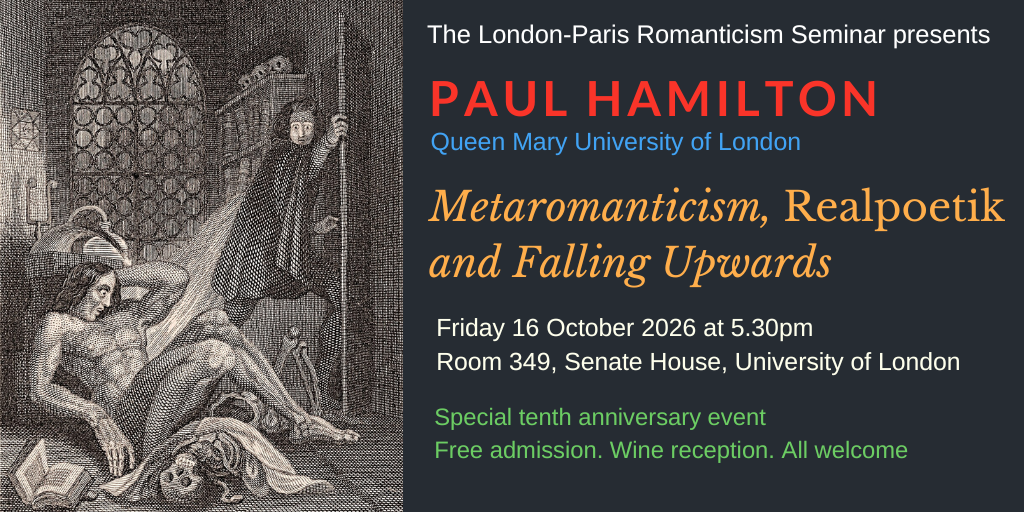
The next meeting of the London-Paris Romanticism Seminar will take place on Friday 16 October 2026 at 5.30pm in Room 349, Senate House, University of London. To open this year’s seminar series and mark the tenth anniversary of the founding of the London-Paris Romanticism Seminar, we are delighted to welcome the renowned Romantic scholar Professor Paul Hamilton of Queen Mary University of London, who will present a paper entitled Metaromanticism, Realpoetik and Falling Upwards. This will be followed by a discussion and wine reception. The event is free and open to everyone, including postgraduates and members of the public. The seminar will be chaired by David Duff.
Paul Hamilton is Emeritus Professor of English at Queen Mary University of London. He has taught at the universities of Nottingham, Oxford, Southampton and London. He has been a Visiting Research Fellow at Ludwig-Maximilians-Universität Munich and a Visiting Professor at La Sapienza, Rome. His last monograph, Orientation in European Romanticism: The Art of Falling Upwards was published by Cambridge University Press in 2023. He is also the author of Metaromanticism (2003), Realpoetik (2013) and edited The Oxford Handbook of European Romanticism (2016).
Regarding the topic of his paper, Paul writes:
“I want to take you for a ride on the roller coaster theme in Romantic thought which has always preoccupied me and which I hope is appropriate to our celebration of ten years of the London-Paris Romanticism Seminar. It begins with Metaromanticism: my term for the way Romantic reflexivity and typically hyperbolic defences of poetry incite poetry’s re-creation elsewhere. ‘The idea of poetry is prose’, as Walter Benjamin thought – it puts us in touch with a general human creativity, poiesis in Greek and Poesie in German, which appears in different forms at different historical moments. Poetry encourages us to translate, to cross artistic boundaries, to update poetic expression, mix genres, and through this progressive, universal poetry recognize what we might become. Initially literary, Metaromanticism inspires Friedrich Schlegel’s Mischgedicht, his and Novalis’s romanticizing Roman, Coleridge’s Biographia Literaria, the ‘poet’ of Keats’s Hyperion poems, the improvised selves of Hemans and L.E.L, Hugo’s poème multiforme, with Wagner’s Gesamtkunstwerk and contemporary multi-media freedoms beckoning. Other forms of textual consciousness discovered by the recent work of Luisa Calè and David Duff on reading the ‘unbound book’ and the ‘literary specimen’ arguably take us further along the same road.
The original Romantic comparative momentum is open-ended. Post-Kantian poets and philosophers thought that poetry was metaphorical through and through, never caught literally but only in its likenesses. Poetry, in other words, need not be confined to aesthetics, but typically refigures itself in other registers, the main way it is poetic. Talk of the ‘poetry’ of anything historically relocates our expressive impulse. Hence Percy Shelley tells the readers of A Defence of Poetry that ‘the true Poetry of Rome lay in its institutions’, not in its literature, and warns us we have lost ‘the poetry of life’. Mary Wollstonecraft Shelley’s Frankenstein is, among many other things, a vivid corroboration of the losses consequent upon rejecting aesthetically (‘I rushed out of the room’) new expressions of our possible humanity. Poetry, unnervingly for any establishment, can translate itself into any form of life, from Mary’s ‘creature’ to Tracy Emin’s unmade bed. Abjection can become sublimity, a falling upwards. We have entered the age of Goethe’s Weltliteratur, anticipating the range of Marx’s arguments for the worker’s right to find satisfactions comparable to aesthetic enjoyment reflected in labour, as he simultaneously attacks aesthetic exclusiveness and the alienation of labour.
Because of its unique invocation of ‘the whole soul of man’, aesthetic education should, in Schiller’s opinion, have ‘every right to command’. Schiller tried to confine such authority to the refinement of a ‘beautiful soul’, but he had let the cat out of the bag: a Realpoetik was now on the march, following the Metaromantic impulse to follow poesis into more timely material forms. Think of Napoleon pulping first editions of Germaine de Staël’s De l’Allemagne, nervous of its political charge; Corinne’simprovisation of l’Italie in Staël’s greatest novel; Don Juan’s Europe; the proto-Risorgimento lyrics of Leopardi. Could this apparently endless process be limited? Is there an abjection which cannot become sublime?”