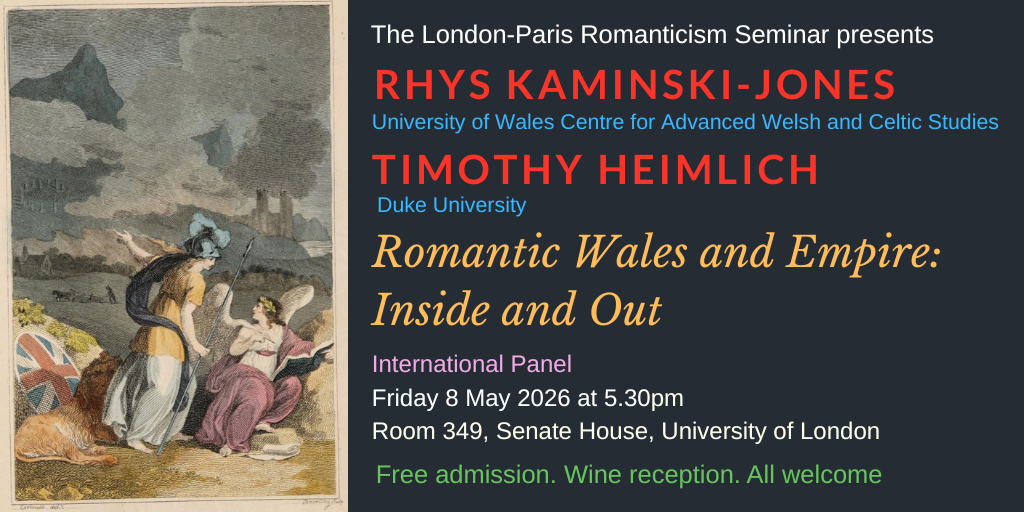
The next meeting of the London-Paris Romanticism Seminar will take place on Friday 8 May 2026 in Room 349 (third floor), Senate House, University of London, starting at 5.30 p.m. This final seminar of the year is an international panel on the theme Romantic Wales and Empire: Inside and Out. As our guest speakers, we are delighted to welcome Dr Rhys Kaminski-Jones of the University of Wales Centre for Advanced Welsh and Celtic Studies, whose talk is entitled St David’s Day in the South Pacific, and Other Welsh Imperialisms, and Dr Timothy Heimlich of Duke University, who will speak on Wales as Periphery, Three Ways. Their abstracts appear below. The two papers will be followed by a discussion and a wine reception. The seminar will be chaired by Gregory Dart (University College London).
This event is free and open to everyone, including postgraduates and members of the public.
Rhys Kaminski-Jones is a Research Fellow at the University of Wales Centre for Advanced Welsh and Celtic Studies. His book Welsh Revivalism in Imperial Britain, 1707-1819 was released in 2025 by Boydell & Brewer. Rhys has published widely on Celtic revivalism, imperial culture, and the long eighteenth century, including articles in the Review of English Studies, Romanticism, and Studies in Romanticism, and the co-edited volume Celts, Romans, Britons: Classical and Celtic Influence in the Construction of British Identities (2020). Currently, he is on the editorial team for a new AHRC-funded online edition of the Welsh travel writer Thomas Pennant (1726–98), and is preparing new research on the Indian travel journals of Henrietta Clive.
Timothy Heimlich is Assistant Professor of English at Duke University, where he teaches and researches British literature of the long eighteenth century. His work has appeared in periodicals including European Romantic Review, Studies in Romanticism, Modern Language Quarterly, and English Literary History. His first book, Wales, Romanticism, and the Making of Imperial Culture, is out this year from Cambridge University Press.
Abstracts:
St David’s Day in the South Pacific, and Other Welsh Imperialisms
Whilst the Anglo-British Romantic gaze often sought glimpses of overseas empire in the people and places of Wales, burgeoning contemporary networks of Welsh cultural revivalism were fashioning new, transnational, and quasi-imperial forms of Romantic Welshness. Beginning with a Welsh poem writtenin the South Pacific on Cook’s third voyage, my paper will complicate the idea of Wales as an object of Romantic imperialism, showing instead how the historically subjugated Welsh grasped opportunities to imagine themselves as imperial subjects. Welsh authors were linked to the wider colonial world through influential expatriate societies in London, and claimed forms of particularised British identity that both appropriated and destabilised the signifiers of British imperialism. From the envisioning of ancient and modern Welsh colonies in the new worlds of the Americas, to firm insistence on Welsh whiteness in the face of derogatory racial theorising, revivalist Welsh Romanticism emerges as a diasporic and ambitiously expansive imperial-era movement. (Rhys Kaminski-Jones)
Wales as Periphery, Three Ways
One remarkable characteristic of long eighteenth-century Anglophone writing about Wales is a tendency to describe the country by reference to distant geographical and cultural analogues. As we might expect, Welsh persons and places were, often enough, compared to English, Scottish, and Irish persons and places during the years 1688 to 1837. But it was just as common for writers to reach for less proximate comparisons: not only places like France, or the Netherlands, or Germany, but also Switzerland, Greece, Italy, modern Bolivia, Peru, Chile, Central America, Mexico, the Midwestern United States, the East Coast of the United States, polar Canada, Greenland, Lapland, South Africa, Egypt, the Levant, southern India, Bengal, Australia, the Pellew Islands, Borneo, Sumatra, and China. This paper focuses upon three texts that render Welsh cultural and geographical difference as racial and/or colonial and asks what is at stake in such characterisations, and how they reflect and refract the fraught enterprise of constructing an imperial British cultural identity. (Tim Heimlich)