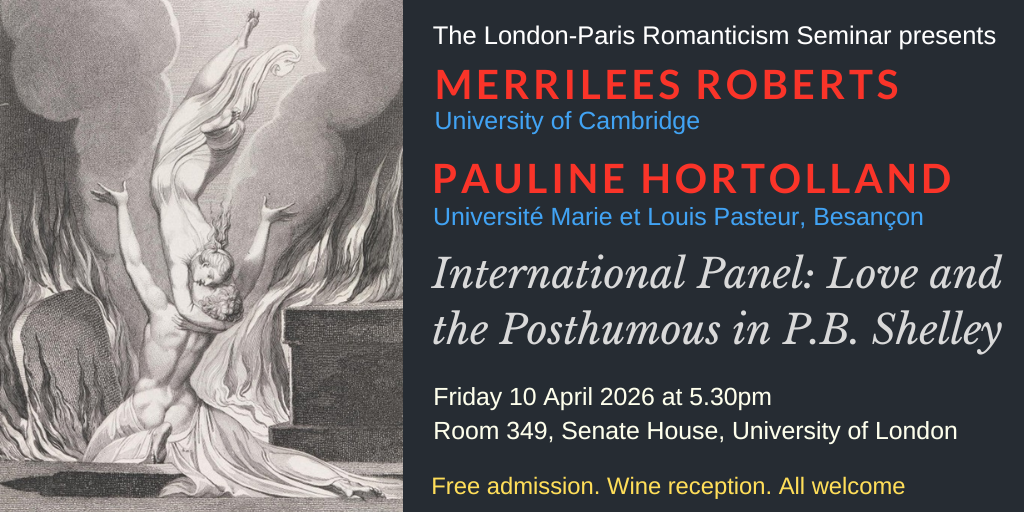
The next meeting of the London-Paris Romanticism Seminar will feature an international panel on Love and the Posthumous in P. B. Shelley and take place on Friday 10 April 2026 in Room 349 (third floor), Senate House, University of London, starting at 5.30 pm. As our guest speakers, we are delighted to welcome two brilliant early career scholars: Merrilees Roberts of the University of Cambridge, who will speak on Shelley’s Epipsychidion: Death, Eros and Inflammation; and Pauline Hortolland of the Université Marie et Louis Pasteur, Besançon, whose paper is entitled ‘The sacred links of that chain’: Love, Fidelity, and Shelley’s Theory of Posthumous Reception in A Defence of Poetry. Their abstracts appear below. The two papers will be followed by a discussion and a wine reception. The seminar will be chaired by David Duff (Queen Mary University of London).
This event is free and open to everyone, including postgraduates and members of the public.
Merrilees Roberts is a Teaching Associate in Literary Criticism & Theory in the English Faculty at the University of Cambridge. She was previously Lecturer in Romanticism at Queen Mary University of London, from where she holds a PhD. She is the author of Shelley’s Poetics of Reticence: Shelley’s Shame (2020), as well as articles on Romantic poetry, affect theory and philosophies of sympathy. She was an organiser of ‘The Shelley Conference 2024: Posthumous Poems, Posthumous Collaborations’, held at Keats House Museum, London. Following this event, she is editing a forthcoming cluster of essays for The Keats-Shelley Journal, titled ‘Affects of Unselfing: Percy Shelley and Collaboration’, which presents theoretical extrapolations of Shelley’s philosophical thinking about the epistemological limits of the self, especially when confronted with more-than-human ontologies. She is also the lead editor of a second publication arising from the Shelley conference, the edited collection Percy Bysshe Shelley in Collaboration: Influence and Intertextuality. This volume will demonstrate how collaborative creative pursuits shaped Shelley’s thought and provided a spur for later writers to converse with his work.
Regarding the topic of her talk, Merrilees writes:
“My paper examines how Percy Shelley re-works Neoplatonic philosophy through the physiological science of his time, particularly Xavier Bichat’s account of the semi-autonomous operations of the tissues. Focusing on Epipsychidion, I argue that Shelley stages a critical parody of Plotinus’s privative theory of matter, in which the diminishment of the mortal body to a mere vessel for the most meagre breath of divine pneuma becomes an implausible precondition for the soul’s ascent toward ideal beauty. Shelley translates Neoplatonic philosophy into an eros that, ironically, suffocates the body of the lover who struggles in vain to find mortal copies of his ideal lovers. He warns us that, in attempting to grasp the fore-pleasures promised by Platonic forms, we risk becoming stuck in a heightened state of physiological arousal which nevertheless points towards speculative materialist philosophy and its peculiar ways of locating eros in the organic operations of life and death.”
Pauline Hortolland is Senior Lecturer in English Literature (Maîtresse de conférences) at the Université Marie et Louis Pasteur, Besançon, France. She completed her PhD, entitled ’Percy Shelley and the Event of Poetry: Mediation, Performance, Virtuality’, in 2023 at Université Paris Cité. Her interests are located at the intersection of Romantic literature, media theory and environmental humanities. She has published research articles in Romanticism on the Net, Keats-Shelley Review, Revue de littérature comparée and Etudes anglaises. This year, she will co-organize with Paul Hamann-Rose (University of Passau) an international conference on ‘New Perspectives on the Romantic Media Concept’ in Besançon on 3-4 September 2026 (cfp available here). She is currently working on her first monograph (under contract with Liverpool University Press), provisionally entitled ‘Shelley’s Ardent Intercessor:British Romanticism and the Poetics of Mediation’.
Pauline offers the following abstract of her talk:
“My paper argues that for Shelley, ‘love’ is not only a popular theme in poetry and a value once forged by poets, but also an ethics of reading which sustains the infinite posthumous ‘power’ of poetry. By using Alain Badiou’s concept of ‘fidelity’, the paper sheds new light on the ways in which Shelley imagines the reception of his poems by future readers. While this reception theory is developed in A Defence of Poetry, it is also prefigured in ‘To a Skylark’ and other poems where the poetic speaker appears as a role model for the reader: ‘The world should listen then – as I am listening now’ (‘To a Skylark’, line 105). By harnessing Badiou’s theory of fidelity to the event, I seek to contribute to a renewed interest in Shelley as a poet of love and relationality.”