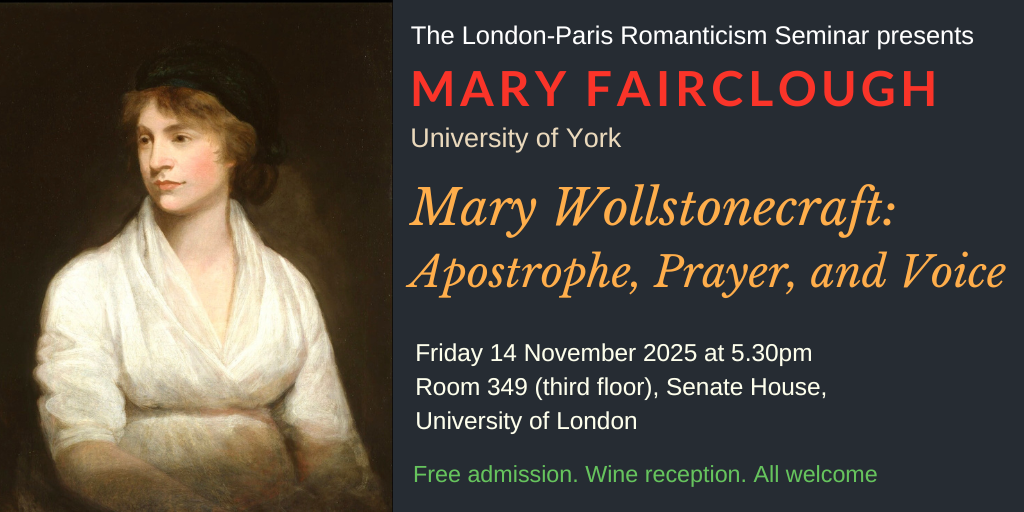
The next meeting of the London-Paris Romanticism Seminar will take place on Friday 14 November 2025 in Room 349 (third floor), Senate House, University of London, starting at 5.30 pm. As our distinguished guest speaker, we are delighted to welcome Professor Mary Fairclough of the University of York, who will present a paper entitled Mary Wollstonecraft: Apostrophe, Prayer, and Voice. This will be followed by a discussion and wine reception. The seminar will be chaired by Rowan Boyson (King’s College London).
This event is free and open to everyone, including postgraduates and members of the public.
Mary Fairclough is Professor in the Department of English and Related Literature at the University of York. Her work investigates the intersection of literature, science, politics and religion in the Romantic period. She is the author of The Romantic Crowd: Sympathy, Controversy, and Print Culture (2013), Literature, Electricity and Politics: ‘Electrick Communication Every Where’ (2017), and Romantic Devotion: Voice, Praise, and Print Culture, 1772-1811 (forthcoming from Cambridge University Press), which was supported by a Leverhulme Trust fellowship. She is editing The Female Reader for The Collected Works of Mary Wollstonecraft (forthcoming from Oxford University Press) and is co-general editor of that edition with Emma Clery. With Catherine Packham, she also co-edited a recent special issue of Women’s Writing on ‘Mary Wollstonecraft, Newington Green and Dissent’ (2024).
Regarding the topic of her paper, Mary writes:
“Mary Wollstonecraft’s use of the rhetorical figure of apostrophe has attracted critical attention, in particular her deployment of apostrophe as part of the rhetorical armoury of A Vindication of the Rights of Woman. This paper takes a different approach to apostrophe in Wollstonecraft’s work, reading it as not just a persuasive tool, but rather as an indicator of Wollstonecraft’s sustained commitment to oral speech and its capacity to produce devotional feeling. I argue that moments of apostrophe in Wollstonecraft’s writings are often structured as prayerful direct addresses to God. I trace the connections between the prayers Wollstonecraft composed for her anthology for reading aloud The Female Reader (1789), and her later political writing and travel writing, making the case for the ongoing importance of vocal utterance and devotional appeal in Wollstonecraft’s works.”